Transfer Meanings and Memories of Company St.
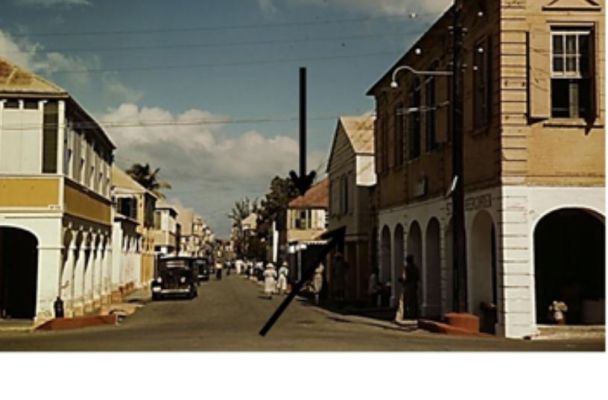
Company Street, Christianted, St. Croix, US Virgin Islands – early 20th century.
Originally published March 2017
by Monique Clendinen Watson
As the Virgin Islands marks the 100th year anniversary of transfer from Danish to American rule, I decided to interview my friend, colleague and socio-political historian Gerard Emanuel for his thoughts on the historic event. Gerard lived at 22 Company Street from the 1950s to early 1960s. He shares his memories of growing up in Christiansted as it transitioned from sleepy post-colonial town to the economic prosperity of the 1960s.

Gerard Emanuel
“I grew up on Company Street, from birth until age 11 when my family lived at 22 Company which was owned by the Catholic Church,” he remembers. “It was fascinating to live on the street and experience the world through jalousie windows. I saw everything from those windows from local vendors selling seven “jojos” for a penny to the newsboy delivering the paper to the milkman bringing fresh milk to our door. I also saw people drunk and cursing and eating out of the garbage. It was an educational experience.”
Living and playing in the Holy Cross churchyard, Emanuel said he also saw the human side of the priests. Ms. Alma Christian cooked for the priests and he remembers the smell of her delicious food and climbing the trees in the churchyard to pick almonds. “You could find anything you wanted on Company Street back then. As the eldest boy in the family, my mother would send me to buy meat from Hendricks meat market and bread from Mencho’s bakery. Local vendors were on their favorite corners selling what people liked to eat. He remembers Ms. Marie’s pastries and cakes, Ms. Jardine’s tarts and Ms. Simmonds’ sugar cakes and peppermint candies.”
“We didn’t have a TV back then, but always had lots of books. Our neighbors were the Molloys and the Woodsons and we would play on the cistern in the churchyard with the Heyligers who were from Sandy Point, St. Kitts.” Like many other Christiansted families, the Emanuels eventually moved to the “country” – to Estate Peter’s Rest.
Gerard is a sought after speaker these days as various community groups seek his perspectives on the 100th Anniversary of the Transfer. He is a former cultural education specialist, public education and executive director for the Status Commission and delegate to the 5th Constitutional Convention.
I picked his brain about the Transfer Document and what it meant for the people of the Virgin Islands, who had mixed feelings 100 years ago, as they do now, because they “knew what they had, but were not sure what they were going to get.” Many of us who grew up and went to school in the Virgin Islands know there was a Transfer, know it meant great change, but never learned much about it except that it happened on March 31, 1917, that there was a ceremony on the major islands as the Danish flag was lowered and the American flag raised and that people cried because they were not sure what it meant for them and their families.
Q: What is the official name of the Transfer Document?
A: The Convention Between the United States and Denmark for Cession of the Danish West Indies. While the Transfer ceremony was held on March 31, 2017, the Convention was signed on August 4, 1916 in New York. It was ratified by the US Senate on September 7, 1916; ratified by Denmark on December 22, 1916 and ratified by the President on January 16, 1917. It was proclaimed on January 25, 1917.
Q: What are the issues addressed in the Articles of the Convention?
A: The Articles addressed protection of property rights, what the Danes would keep such as military equipment and rights to the West Indian Company dock, how much money was to be exchanged ($25 million in gold), what happened to those with matters before the courts, and the rights of citizens, subjects and inhabitants of the islands.
Q: What is the most important issue addressed in the Convention document?
A: The most important to me are Articles 2 and 6, particularly 6 which addresses the rights of citizens and inhabitants. Article 6 addresses “Danish citizens” and “inhabitants” separately. It grants “citizens” the right to choose to remain in the islands, keep their property, preserve their Danish citizenship or become Americans. It states that “the civil rights and the political status of the inhabitants of the islands shall be determined by the Congress, subject to the stipulations contained in the present convention.”
For Emanuel and others who have worked on our status commissions and constitutional conventions, the fact that residents at the time were referred to as “citizens” “inhabitants” and “subjects” create a murky distinction as to what rights and privileges belong to Virgin Islanders of African descent vs. Danish citizens. “The term ‘inhabitants’ generally refers to people of African descent in the Law of Nations,” he states. “My position is that they were not considered citizens, for if everyone residing had a recognized nationality or citizenship, what would have been the reason to identify this body of persons by using this language?”
The Transfer was followed by Navy rule and American citizenship was not officially conferred upon the former “citizens” “inhabitants” and “subjects” until 1927. Virgin Islanders, both here, Rothschild Francis and D. Hamilton Jackson and abroad Casper Holstein and others fought for an end to Navy rule and the granting of citizenship and its attending rights. Citizenship came with the 1927 US Citizenship Act which states that “Be it enacted by the Senate and the House that the following persons and their children born subsequent to January 17, 1917 are hereby declared citizens of the United States.” Later in the 1940 Nationality Act passed by the 69th Congress re-affirmed that “the following persons and their children born subsequent to January 17, 1917 and prior to February 25, 1927 are declared to be citizens of the United States as of February 25, 1927.” This included all former Danish citizens residing the islands, the United States or Puerto Rico, all natives who resided in the islands, the United States and Puerto Rico on January 17, 1917 or February 25, 1927 as long as they were not citizens or subjects of any foreign country.
Emanuel continues his argument that full citizenship rights were never granted, not only because the rights to self-governance and self-determination and the right to vote for President were not granted, but also because “natives of the Virgin Islands of the USA are U.S. citizens merely pursuant to a law passed by Congress, not pursuant to any of the two areas in the U.S. Constitution that provide the basis for US citizenship. Any future Congress could pass a law and remove this privilege because according to the U.S. Courts and former President Obama U.S. citizenship is only a privilege, not a right.”
Q: How did the Transfer affect the economic, political and social development of the U.S. Virgin Islands?
A: The Transfer left the U.S. Virgin Islands outside of the U.S. Customs zone and exempted from the Jones Act. Being outside the Customs zone gave the territory the duty-free advantages that bolster our tourism industry and the Jones Act exemption allowed for foreign shipping between two U.S. ports which bolstered the oil and alumina refining and boating industry. “Those industries provided for the economic prosperity of the late 20th century, but none are now as viable as they once were.” He said that the social safety net provided by federal dollars, to include welfare, food stamps, Medicaid and Medicare, are also a major part of the Virgin Islands economy.
Politically, the Virgin Islands have gained the right to elect their own local Governor and Legislature, but have failed to choose a status option other than the present “unincorporated territory.” They have not approved a Constitution and do not have the right to vote for President of the United States. “Clearly from a political point of view, the Virgin Islands is behind just about every independent country in the Caribbean. These countries have taken their rightful place in the world of nations and directly represent their concerns to international bodies,” he said. “They can also negotiate lucrative investment and trade agreements with other countries on their own.” Socially, we are the melting pot of the Caribbean, with migration from all over the Caribbean by people who see the Virgin Islands as the gateway to the United States and when the economy was more robust, came to take advantage of economic opportunity.
Emanuel does not foresee any major changes to status or self-determination in the near future. “Many Virgin Islanders complain about some of the lack of freedoms, rights and privileges that exist here, but they do not seem to be willing to do what is needed, which is to change the status of this territory. This sense of schizophrenia may also be due to fear and lack of confidence in our ability to survive without the largesse of the USA. Some local residents are afraid that we lack natural resources, and that we are too small to go on our own. Others also feel that we will not do any better than we currently are doing under the USA, and that we will do worse. So these persons are willing to accept this obviously colonial status because it provides a sense of security and comfort, and because they are not willing to take the risk of changing it since they perceive no benefit in doing so.”
For more on the Transfer, status and self-determination Emanuel suggest that you read William Boyer’s America’s Virgin Islands – A History of Human Rights and Wrongs. For more about Christiansted and Company Street I suggest Karen Thurland’s The Neighborhoods of Christiansted 1910 to 1960. I am sure there are copies at libraries in the U.S. Virgin Islands www.virginislandpubliclibraries.org or at the St. Croix Landmarks Society at www.stcroixlandmarkssociety.com or at Virgin Islands bookstores like Undercover Books at www.undercoverbookstcroix.com.Since the U.S. Virgin Islands is commemorating You can find information on the Transfer at www.vitransfercentennial.org.
As the world we live in is global and interactive, I would like to hear from you who know and love St. Croix who may have stories, pictures or memories to share about Company Street. Contact me at mcw@bluegaulinmedia.com or follow me on Facebook @companystreetchronicles or on Twitter @companystreet59.
Monique Clendinen Watson is a writer and public relations specialist who is from the U.S. Virgin Islands and who lives in Virginia. She owns a public relations firm, BlueGaulin Media Strategies, www.bluegaulinmedia.com . Photos from the Library of Congress, Gerard Emanuel, Neal Watson, and Monique Watson..
© Company Street Chronicles and Bluegaulinmedia are copyright protected. February 2017. All rights reserved.
© 2017 BlueGaulin Media. All Rights Reserved.
 Company Street Chronicles
Leave a comment